The first snowfall in Calgary brings an electric buzz. Everyone starts talking about weekend trips to Banff, Lake Louise, or Nakiska. Skis and snowboards come out of storage, boots get buckled, and for many of us, it’s the best part of the year.
But every winter, a familiar pattern emerges. People head straight from a desk job to the chairlift. A few runs later, their knees are aching, their backs are tight, or they’re nursing an injury that cuts the season short.
It’s not about being “out of shape.” Most of us are active—we cycle, go to the gym, or walk to work. The problem is that skiing and snowboarding ask for a totally different kind of strength: explosive power, balance, and control under fatigue.
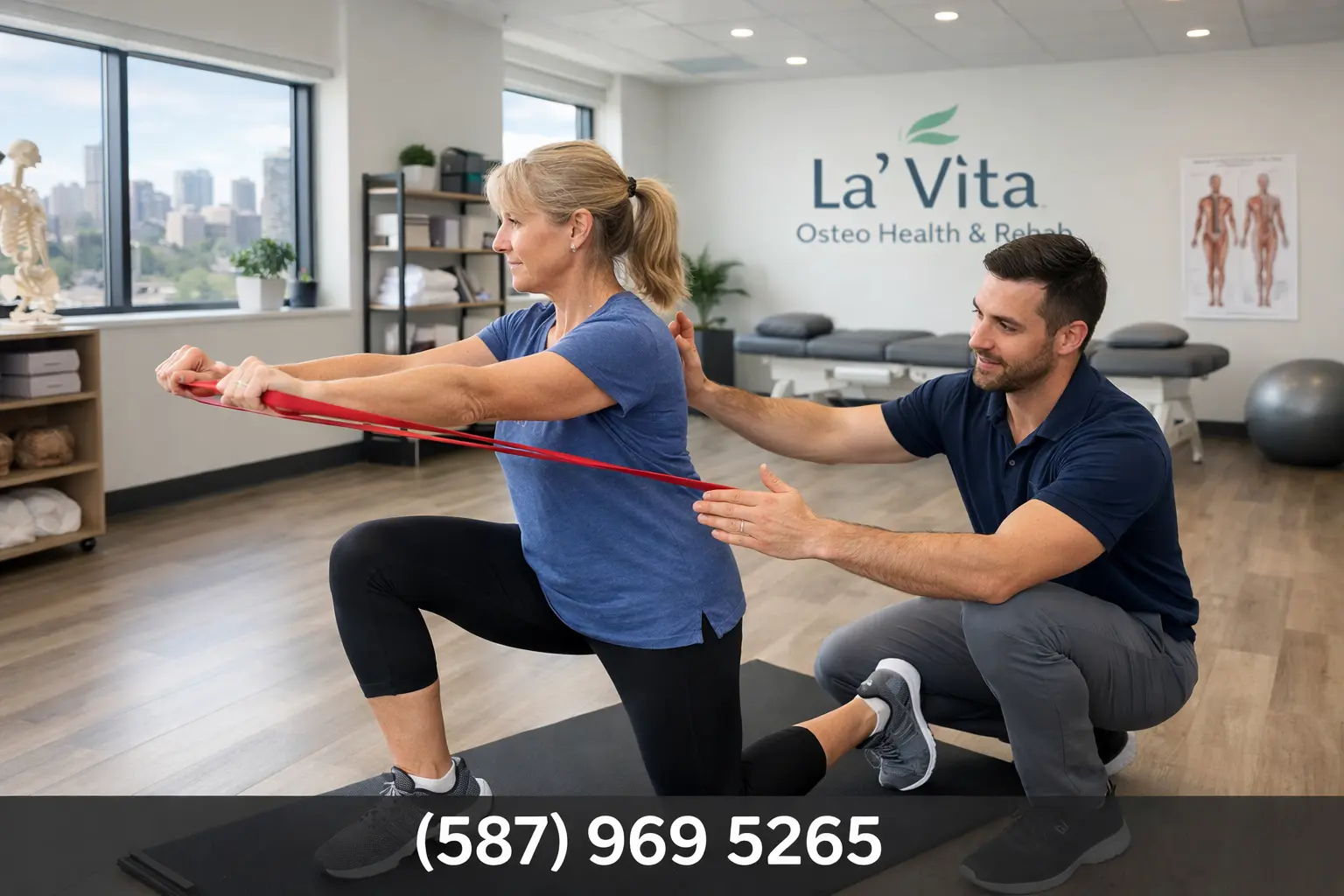
This is where ski conditioning makes all the difference. By preparing your body before the snow flies, you can reduce your risk of injury and make those first days on the mountain far more enjoyable. If you’re planning trips to Nakiska, Sunshine Village, or Lake Louise this season, explore our active rehabilitation services to build a strong foundation for the slopes.
Why Ski Conditioning Matters for Skiers and Snowboarders
Skiing and snowboarding place unique demands on the body. Unlike running or cycling, these sports require rapid, explosive movements, sudden changes in direction, and the ability to maintain control on uneven terrain while your muscles are fatigued.
Research shows that targeted preseason training and screening can cut injury risk by up to 40%. Yet many Calgary skiers and snowboarders wait until the first chairlift to prepare their bodies. This is why ski conditioning is so important—it helps your body adapt to the specific demands of the sport.
For every thousand days people spend on the slopes, two to four will end with someone getting hurt badly enough to need medical care. With Sunshine Village and Lake Louise seeing thousands of visitors each day, that adds up quickly.
The good news is that most of these injuries are preventable. Proper ski conditioning helps your body handle the physical demands of the sport, especially during those first few sessions when your muscles aren’t yet accustomed to the workload.
Common Early-Season Skiing and Snowboarding Injuries
Understanding the most common injuries helps you know what to prepare for. For skiers, the knees are particularly vulnerable, with knee injuries accounting for over 30% of all skiing injuries across the body.
ACL and MCL Injuries
The anterior cruciate ligament (ACL) and medial collateral ligament (MCL) are the most commonly injured ligaments in skiing accidents. These injuries often occur during sudden twists, awkward landings, or when a fall forces the knee into an unnatural position.
Research indicates that even a small imbalance or misstep can put tremendous pressure on these structures. This is why ski conditioning is so important—it helps build the strength and control needed to protect your knees.
Wrist and Shoulder Injuries in Snowboarding
Snowboarders are more likely to hurt their wrists, shoulders, or head from falls. Nearly half of snowboard injuries happen to beginners in their first season, often because they haven’t yet developed the balance and control needed to stay safe.
Muscle Fatigue-Related Injuries
Even experienced riders aren’t immune. Fatigue and poor conditioning are behind most late-day wipeouts. As your muscles tire, your technique deteriorates, and your risk of injury increases significantly. Proper ski conditioning helps delay fatigue and maintain good form throughout the day.
How to Protect the ACL and MCL on the Slopes
Protecting your knees starts with strengthening the muscles that support them. The glutes, quadriceps, hamstrings, and core all play crucial roles in knee stability.
When these muscles work together properly, they help maintain proper knee alignment and absorb the forces that can otherwise damage ligaments. Ski conditioning targets these specific muscle groups to build the strength and control needed for safe skiing.
Here’s how each muscle group contributes:
Glutes: Crucial for hip and knee alignment. Strong glutes help prevent the knee from caving inward during turns and landings.
Quadriceps: Control knee extension and absorb shock during turns and jumps.
Hamstrings: Balance the quads and protect the knee joint.
Core muscles: Improve balance and reduce stress on the knees.
Calves and ankle stabilizers: Help manage terrain changes and improve control.
Proper technique also matters. Most knee injuries happen with sudden, wrenching movements or improper technique. Before hitting the big slopes, brush up on your skills in a safe training area. Good stopping, falling, and turning techniques can save your knees from a lot of damage.
Why Core Stability Matters for Better Edge Control
Core stability is often overlooked in ski conditioning, yet it’s essential for controlling your body on the slopes. A stable core helps you transfer energy efficiently to your arms and legs, maintain better balance, and reduce stress on your joints.
When you’re skiing or snowboarding, your core works constantly to keep your upper body stable while your lower body navigates the terrain. This is especially important during turns, where there’s a lot of twisting back and forth through the abs.
But core stability isn’t just about strength—it’s also about control. Your spine needs to be both stable and mobile at the same time. This means training your core to stabilize in different positions while allowing your spine to move naturally.
Fundamentally, a stable core protects your spinal cord, which is the main information highway by which your brain communicates with the rest of your body. Without good core control, other body parts like your hips will try to compensate, potentially leading to injury. Effective ski conditioning always includes core exercises.
Active Rehab Exercises for Ski Season Preparation
The following exercises are designed to help you prepare for the slopes as part of your ski conditioning routine. Remember that these are general recommendations and not a substitute for professional assessment. If you have a previous injury, persistent pain, or any concerns, consult a professional before starting any new exercise program.
Squats
Squats build the quadriceps, hamstrings, and glutes—the powerhouse muscles you need for skiing and snowboarding. They also mimic the athletic stance you’ll use on the slopes. This fundamental ski conditioning exercise should be part of every program.
How to do them: Stand with feet hip-width apart. Lower your body as if sitting back into a chair, keeping your weight in your heels and your chest upright. Aim for 3 sets of 10-15 reps.
Lunges
Lunges develop single-leg strength and control, which is essential when you’re turning or landing on one leg. This is a key ski conditioning exercise for building balance.
How to do them: Step forward with one leg and lower your hips until both knees are bent at about 90 degrees. Keep your front knee aligned with your ankle. Aim for 3 sets of 10 reps on each leg.
Step-Downs
Step-downs mimic the controlled lowering motion you use on the slopes. They help strengthen the eccentric control in your quadriceps—the ability to control your body weight as you descend. This ski conditioning exercise targets the muscles you’ll use most on descents.
How to do them: Stand on a low step (6-8 inches). Slowly lower your opposite foot to touch the floor, then return to standing. Control the movement—don’t drop quickly. Aim for 3 sets of 10 reps on each leg.
Single-Leg Balance Exercises
Balance is crucial for staying upright on uneven terrain. Single-leg balance drills also strengthen the stabilizing muscles around your knees and ankles. These are essential for any ski conditioning program.
How to do them: Stand on one leg for 20-30 seconds, then switch. For an added challenge, close your eyes or stand on an unstable surface like a cushion. Aim to build up to 30-60 seconds on each leg.
Glute Strengthening
Strong glutes are essential for maintaining proper knee alignment. Clamshells and lateral band walks are excellent choices for your ski conditioning routine.
How to do clamshells: Lie on your side with your knees bent at 45 degrees. Keep your feet together and lift your top knee like a clam opening. Aim for 3 sets of 15 reps on each side.
How to do lateral band walks: Place a resistance band around your ankles or just above your knees. Take small steps sideways, keeping tension in the band. Aim for 3 sets of 10 steps in each direction.
Core Stability Exercises
Core exercises for skiing should include flexion, extension, rotation, and stabilization. Planks, V-ups, and trunk rotations are all effective for ski conditioning.
Planks: Hold a forearm plank for 30-60 seconds. This builds core stability without putting stress on your lower back.
Supine Rotation: Lie on your back with knees bent. Engage your core and slowly twist your hips from side to side. This mimics the rotational demands of turning on the slopes.
At La Vita Osteo, our kinesiology services can help you develop a personalized ski conditioning program.
How to Build a Pre-Season Ski Conditioning Routine
For best results, begin your ski conditioning program six to eight weeks before your first day on the mountain. This allows time to build strength and endurance gradually while avoiding overuse injuries.
Start with bodyweight movements and mobility work, then gradually increase intensity. Aim to exercise two to four times weekly, focusing on both strength and stability. A comprehensive ski conditioning routine should include strength training, balance work, and core stability exercises.
The pre-ski routine, including dynamic stretching, should take at least 15 minutes to complete. Warming up before skiing is just as important as conditioning—it helps your muscles prepare for the demands of the slopes.
After skiing, take time to cool down. A cool-down allows your body to gradually return to its resting state and may reduce your chance of developing muscle soreness. Static stretches should be part of your post-ski routine, holding each stretch for 20-30 seconds.
For more guidance on building your ski conditioning routine, visit our blog for expert tips and advice.
When to See an Athletic Therapist or Rehabilitation Professional
While self-directed ski conditioning can be effective, there are times when professional guidance is essential. Consider seeing an athletic therapist or rehabilitation professional if:
You have a history of knee injuries: Previous ACL, MCL, or other knee injuries increase your risk of re-injury. Professional assessment can help identify any lingering weaknesses or imbalances that your ski conditioning program should address.
You experience persistent pain: Pain that doesn’t improve with rest or that interferes with your daily activities warrants professional evaluation before starting a ski conditioning program.
You have limited mobility: If you can’t squat fully with control or have restricted ankle mobility, a professional can help identify and address the underlying causes.
You want personalized guidance: Everyone’s body is different. A professional can design a ski conditioning program tailored to your specific needs, goals, and any existing weaknesses.
You want to maximize your performance: Even if you don’t have pain, a readiness screen can help identify areas where you can improve to reduce your injury risk and perform better on the slopes.
At La Vita Osteo, our osteopathic therapy and athletic therapy services can help identify and address underlying issues before you hit the slopes.
FAQs
1. When should I start my ski conditioning program?
Ideally, start six to eight weeks before your first day on the mountain. This gives you time to build strength and endurance gradually. But even if you’re starting late, beginning a ski conditioning program is always better than doing nothing.
2. What exercises are best for ski conditioning?
An effective ski conditioning program should include squats, lunges, step-downs, single-leg balance drills, glute strengthening exercises, and core stability work like planks and rotations.
3. How important is core stability for skiing?
Core stability is critical for skiing. A stable core helps you maintain balance, transfer energy efficiently, and reduce stress on your knees. Any good ski conditioning program should include core exercises.
4. Should I stretch before or after skiing?
Both! Dynamic stretches are best before skiing as part of your ski conditioning warm-up. Static stretches are better after skiing as part of a cool-down.
5. How often should I do ski conditioning exercises?
Aim for two to four sessions per week as part of your ski conditioning routine. Consistency is more important than intensity—regular practice builds the strength and control you need.
6. Can I do ski conditioning at home?
Yes! Many ski conditioning exercises like squats, lunges, planks, and single-leg balance drills require no equipment and can be done at home with minimal space.
7. Does La Vita Osteo offer ski conditioning programs?
Yes! We offer active rehabilitation, athletic therapy, and kinesiology services designed to help you prepare for the slopes safely and effectively. Contact us to learn more.
Conclusion
Calgary’s proximity to world-class ski destinations like Nakiska, Sunshine Village, and Lake Louise makes it a paradise for winter sports enthusiasts. But the best powder days are the ones where you can ski or snowboard all day without injury or excessive soreness.
Ski conditioning isn’t about being a professional athlete—it’s about giving your body the strength, stability, and control it needs to handle the demands of the slopes. By starting your preparation early and focusing on key areas like knee protection, core stability, and balance, you can significantly reduce your injury risk and make this season your best one yet.
At La Vita Osteo, we understand the unique demands that skiing and snowboarding place on the body. Our team offers Active Rehabilitation, Athletic Therapy, and Kinesiology services designed to help you prepare for the slopes and recover from any issues that arise. We can help you build a personalized ski conditioning program that addresses your specific needs and goals.
Ready to make this ski season your strongest one yet? Book your assessment at La Vita Osteo today and start building the foundation for a safe, enjoyable winter on the mountain. Visit our website to learn more, or explore our blog for more winter wellness tips.